
Documentary textual sources that signify the presence of market women and their role in Dublin’s secondary economies are scant, yet a wide range of visual media confirms their presence and place in Dublin’s socio-economic history, offering new perspectives on how these ‘market women’ negotiated space, economies, and public perceptions of their activity.
The terms ‘formal and informal,’ ‘legal and illegal,’ and ‘authorised and non-authourised,’ framed public discourse around street market trading in Dublin from the sixteenth to the mid-twentieth century, linked to legislative bodies aimed at regulating non-fixed and casual trading in the city. These concepts were also framed by rapid developments in Dublin’s trading environments in the late nineteenth and early twentieth centuries, in which the perpetuation of traditional street markets was considered a contradiction of the growth of built market spaces that projected modernity and civility. Women in street markets were implicated within this dichotomous framing, where shop traders, the city authorities, and the constabulary persistently questioned their legitimacy as fixed businesses. Visual culture during the nineteenth and early twentieth centuries – paintings, prints, photographs, and ephemera – reveals such tensions, and evidences the presence of these market women and their relationship to Dublin civic spaces, influencing public perceptions of their activity and labour.
Visual and ethnographical chroniclers commonly characterised street and outdoor market trading women as disorderly, when compared with those who worked in bricks and mortar businesses in the city. Thus, the physical space ‘market women’ occupied in Dublin – whether they were purely ambulatory street sellers, worked in semi-permanent or fixed market spaces, or were employed in built shops – reflected a spectrum of social hierarchies,
as well as hierarchies of order and morality, that were also visible and codified in the media representing them for (visual) consumers.
Dublin’s long history of both empathy and resistance toward informal street and market trading was further amplified in the 1920s during the formation of the Irish Free State, buoyed by nationalist desires to promote external and internal perceptions of Ireland’s capital city as civilised, thriving, prosperous and sanitary. Here once again market women’s presence and visibility proved a flashpoint for how a cosmopolitan, newly independent Dublin should appear to residents and visitors. Apart from visual media, this research engages with documentary sources that offer evidence of female traders in street and purpose-built formal market buildings, found primarily in claims made by dealers in lieu of damaged or destroyed property, and changes to Dublin’s urban topography, as reported in contemporary news. For example, claims made by traders after a fire destroyed most of the South City Market on Great George’s Street in 1892 (the same year as the Mary’s Lane fruit and vegetable market opened on the city’s northside) offer some insight into the place of market women in late nineteenth-century Dublin. Documentary evidence of informal and formal marketing women is also available (in the National Archives) via claims made to the Property Losses (Ireland) Committee for stock and equipment damaged or destroyed during the 1916 Rebellion in Easter week of that year, which many informal traders had also overtly objected to, due to loss of earnings from both trade and military welfare systems in place.
The visual materials informing this research have been gathered using a variety of sources including maps, drawings, paintings, prints, and photography (including glass plate negatives, lantern slides, photographic prints, and photomechanically reproduced photographs in books and periodicals), held in national and local archives and libraries, and private collections. The reproduction of many of these images in popular print media includes their use in travel directories, illustrated dictionaries, and magazines, where the identities of most of Dublin’s
market women remained anonymous to the viewers of these images. While text-based sources are valuable for outlining the types and costs of commodities market women were selling, dealing, or hawking in Dublin’s late nineteenth and early twentieth century, letters that accompanied a number of these claims (as held in letters from stallholders and proprietors included in the South City Market Fire Relief Fund, 1892, DCLA, Street Market and built market dealers claims in the Property losses (Ireland) Committee files in the NAI), offer additional insight into the lived experience of some of the many women who relied on authourised and non-authourised market economies, where the state provided little or no financial assistance. By investigating a diverse range of visual materials, in conjunction with written documentary sources, a wider understanding of the role women played in this sub-section of Dublin’s economic stratigraphy is revealed.
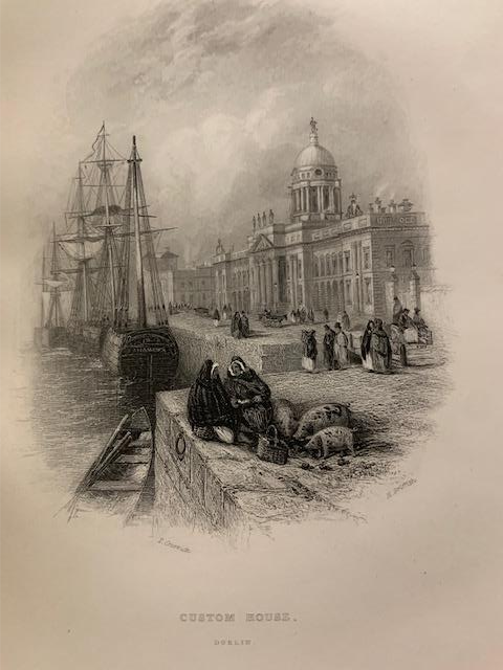
Basket women at the Custom House Quay, print from an engraving by Henry Griffith (c. 1840) after a painting by Thomas Creswick (1837), also published in Vol. II, of Hall’s ‘Ireland: Its Scenery, Characters &c.’ 1841. Image, author’s own.
Bio
Dr Susan Curley Meyer’s PhD thesis ‘Regulation, Resistance, and Resilience: The Visual Culture of Dublin’s Female Street Traders (c. 1870s – 1920s),’ undertakes an art historical study of street trading in Dublin, investigating both the makeshift economies employed by women in the city, and the range of visual media used to represent them. While a mode of survival for many women, street trading also maps the establishment and movement of enduring labour networks, including organisations and systems in place in contemporary major industrial cities, largely implemented and run by women.

