
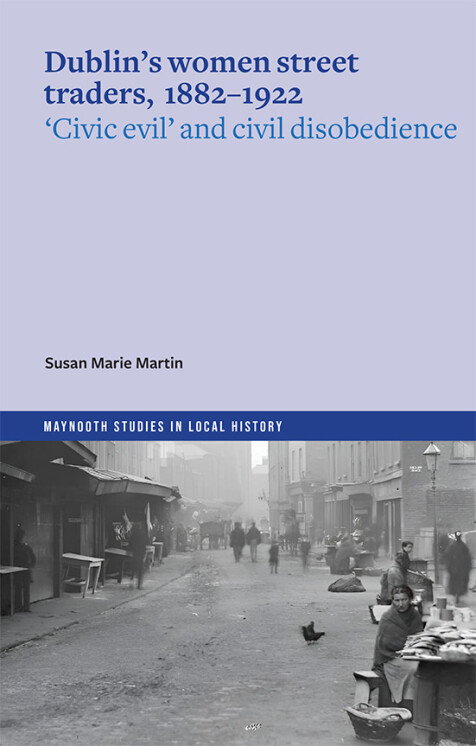
As Susan Marie Martin says, Molly Malone, the cockles and mussels street trader, rendered
in a bronze sculpture, was unveiled to celebrate Dublin’s millennium, in 1988. It makes the
city sound like a haven for those stalwart women. The reality on the ground told a different
story, however. In 1982, new laws introduced heavy fines for ‘illegal street trading’, resulting in imprisonment for traders who couldn’t afford the fines, alongside TD, Tony Gregory’s
imprisonment, for supporting them (RTÉ 1986). These women, often mothers of large families, sole breadwinners in their households, were a far cry from the depiction of Molly
Molone, (p. 9), whose breasts are frequently rubbed for luck, resulting in a very shiny bosom.
The late sculptor, Jeanne Rynhart, maintained that the clothing and appearance were accurate for women of that era, (Irish Times, 2019). In many ways, though, the Molly Malone sculpture is a metaphor for women street traders over the years, stalwart warriors feeding the city. However, Molly Malone’s story in the song sharply contrasted with Biddy Mulligan’s story, the almost equally famous street trader. Poor Molly, having followed in her parents’ footsteps, died as a young, buxom maiden, as depicted the sculpture. That mysterious fever carried her off, reflecting poor life expectancy of so many in her class and gender, but ensuring her forever young and beautiful legendary profile. Meanwhile Biddy Mulligan, a widow with a child, survived and thrived, sustained by her stall in Patrick Street, in the Liberties, conceivably among the traders in the photograph (depicted on page 19 of Martin’s book). However, neither Molly nor Biddy of song and story reflected the lives of real street traders, whose labour and breadwinning were diminished and degraded by the retailers, property owners, and the law. The book is organised into an introduction, three chapters, and conclusion, interspaced by very interesting figures, which illuminates the text. Martin has consulted a very wide range of sources, resulting in a study that sheds light on a cohort of the population who have been overlooked and forgotten in spite of their essential role in feeding the people, especially those who lived hand to mouth through poverty, unemployment, disability, conditions to which both children and women were particularly vulnerable. The sub-title of the publication: ‘Civil evil’ and civil disobedience could describe any women who defied the prevailing gender norms, including women working in prostitution, and women working for women’s rights, regardless of the social demand for the services and the historical affirmation of the cause. Furthermore, the publication has foregrounded the acts of resistance by the women street traders, a fight that continues, with the decline in capacity in traditional trading areas, especially Moore Street. This is in stark contrast to the parallel activism of civil disobedience of the suffrage and civil rights movement during those same turbulent years.
The Study
Martin’s timeline for this research, 1882-1932 stretches over years of rebellion, revolution, social movements, and profound social change in Ireland, concluding in the first decade of the Free State. Dublin witnessed growing urbanisation, with a steep decline in agriculture. Factory work took over from weavers, spinners, confectioners, distillers, brewers, and so on, places of employment for many women. Furthermore, traditional employment, like domestic service, did not want married women, or women with children, while street trading provided flexible, assessable work. However, her research shows that street traders were most likely to be perceived as an unruly underclass, the ‘sources of dirt, disorder and contagion’ (p.12), rather than the reality of misogyny, poverty, and the tradition of selling on the street. Today, many local authorities are encouraging farmers’ markets, fish merchants, organic vegetable stalls, soap sellers, jewellers, wood workers and so many others to ply their goods in village squares, festivals of all sorts, and in the court yards of Big Houses. The perception of street trading has changed with the elevation of status to the smart, cultured, resourced social classes, a telling contrast to the ‘civil evil’ of women street traders.
Martin argues that this topic is under-researched, and she uses correspondence and internal police reports; minutes and reports of Dublin Corporation; records of the Oireachtas; supplemented by local and national newspapers, whose stories often covered details that were omitted from the official sources. She starts with an analysis of the outcome of the 1875 Act on Public Health, which extended the Local Government Act of 1858, giving the power to local government to establish markets. However, Dublin Corporation had done little or nothing to improve standards of market trading, in contrast to Cork which had six markets,
and Belfast, which had 10, serving the population and supporting the traders. Dublin did not
have proper outlet for whole distribution of fresh food, and although, the city had eight
private markets, but they were deemed to be well below public health standards and, in addition, did not have the capacity to provide for the expanding city. That meant that street
traders were essential in getting food to the consumers (p. 16). The situation did not improve during the fight for Irish independence nor in the Free State. The absence of provision for trading resulted in a huge crack-down on women traders, so much so, that the courts were overwhelmed by cases brought against the women traders. A Judge Collins complained that the courts couldn’t manage, and that the corporation ought to regulate street trading instead of penalising the traders, to ultimately reduce prosecutions (p.27). Nevertheless, the prosecutions of traders continued, with corresponding resistance. A protest march proceeded from George’s Street, and across the Liffey until they returned to the Mansion House in Kildare Street. They carried placards and banners, including the notable: IS IT RIGHT OR FAIR THAT WE SHOULD BE PREVENTED FROM EARNING AN HONEST LIVING?
This banner echoes the support of one of the magistrates who defended the women, when it was claimed that they were peddling, for example, ‘bits of heather and faded bunches of flowers’ by one letter writer to the Irish Times, and other authorities maintained that they were ‘depositing rubbish’ and leaving ‘filthy messes’. The magistrate observed that it was not
‘a crime for these poor people to earn their living as flower sellers,’ (p.35). Martin also identified another crucial issue. The 1901 and 1911 census overlooked the nature of work performed primarily by women, and the nature of the street traders work often meant frequent address changes, making it difficult to keep track of women who were identifiable. All the same, Martin highlights a few gems that she discovered in her study of the census, namely the stories of individual women and families. One, Margaret Wade, aged 39, a widow with four children, sold fruit at Nelson’s Pillar. Two of her children followed in her footsteps, like Molly, but, parallel to Biddy Mulligan’s ‘palace’ – consisting of one room– Margaret was a widow and had the luxury of two rooms (p.21). Overall, Martin makes the point that street trading was relatively cheap and easy to set up, allowing women access to economic resources, especially at a time when traditional employment, such as agriculture labour, was declining, and domestic work was limited for older woman and women married with children. And of course, the consumer demand for affordable food and clothing was steady among equally poor people, the model of micro economy, invisible to the more powerful City Fathers.
Moreover, as the city of Dublin expanded, among the blind spots of those powerful City Fathers was feeding the growing population. Not only did street traders provide nourishment at affordable prices, sometimes at great cost to themselves, but the inadequacy of the statutory provision of markets stood out. A stark account of the women’s interactions with the other authorities, particularly the Garda, is explored in Chapter Three, ‘Keeping Body and Soul Together’: arrests, resistance and muted victories. Judge Collins, mentioned above, interrogated the extent of the arrests of a group of women by a Garda Ahearn, who seized their products in the process, and refused to return them when the case against them was adjourned a number of times, while the legal status of the arrests was questioned by Judge Collins. This chapter is a powerful spotlight on the nitty gritty of the experience of the women at the hands of the law, which sometimes overreached to the detriment to the lives of the women, quite apart from breadwinning, especially with regards to their fitness to parent their children, in the face of the pressures to put bread on the table. This is a particularly poignant chapter and well done to Martin for focusing on it.
Conclusion
I enjoyed reading this publication immensely. I grew up in Francis Street, the location of the Iveagh Market and so many street traders, whom we all depended on to provide us with fresh fruit and vegetables. Susan Marie Martin’s research had shone a bright light on the inner city, and especially, on the ways in which women were treated both before independence and afterwards. This is a rich addition to the intersectional analysis that feminist researchers and theorists have compiled over the years, and it is much appreciated. As the saying goes, nobody is free until everyone is free, and these women have endured a very unfair deal in the essential work of feeding the people. The stories of individual women and families are especially powerful. I took the liberty to look up some of the names mentioned in the newly published 1926 census, which is another telling story. While this publication is written in an academic style, a publication by Martin, aimed at the general reader would very welcome, because this is a slice of Dublin life focuses on essential history of women, working class families, and the city, which is of profound interest to so many people.
References
RTE Archives RTÉ Archives | Society | Street Traders Demonstration, accessed 27 April 2026.
Harrison, Bernice, (2019) Shining example – An Irishwoman’s Diary on the Molly Malone statue and inventing a tradition – The Irish Times accessed 27 April 2026.
Molly Malone – The Dubliners & Jim McCann | Festival Folk (1985) – YouTube accessed 27 April 2026.
Biddy Mulligan – YouTube accessed 27 April 2026
Biography
Brid Connolly recently retired from Maynooth University, where she worked in the Department of Adult and Community Education for nearly forty years. She specialised Women’s Studies early in her career, eventually developing into Gender Studies, perceiving these disciplines as the academic arms of social movements. She worked from the assumption that the role of adult and community education is to prioritise equality, fairness, and emancipation.

