
In 2022, an article written by Frances Nolan and Bronagh McShane in the Irish Historical Studies celebrated thirty years since the publication of ‘An Agenda for Women’s History in Ireland’ which inspired a wave of new scholars working on women’s history. In this recent agenda, Nolan and McShane note that ‘the landscape has changed immensely in respect of accessibility’. This is a result of a marked increase in the publication of printed primary sources, the emergence of online databases and advancements in archival practice. At the conclusion of their piece, they also mention that ‘aspects of emigrant women’s lives and experiences require further development including more investigation into emigrant women and work […] and emigrant women’s integration into new communities.’
I recently started working on French Huguenot women who migrated from France and took refuge in Dublin, and more broadly in Ireland during the early modern period. The Huguenots are Calvinists who left France in exile after the Edict of Fontainebleau in 1685, which disallowed freedom of religion. However, I have been struck by the difficulty of finding secondary and primary sources mentioning those women. As any early modernist will tell you, archives in Ireland from this period are notoriously missing part of their collection since the 1922 fire at the Four Courts. Add to this the fact that women are particularly absent from archives of the time, and finding any information becomes akin to a treasure hunt. However, French Huguenot archives were mostly contained by the French Calvinist Churches of the time and spread between England, Ireland and France. As a consequence, unlike many other early modernists, I found myself inundated by potential archives.
As I kept digging, however, a fi rst problem arose. Nothing appears to have been written specifically focusing on French Huguenot women and their status as refugees. More than that, they are simply not mentioned. In A Companion to the Huguenots published in 2016, one chapter written by Amanda Eurich mentions ‘Women in the Huguenot Community’, and focuses on their place within the Calvinist tradition.
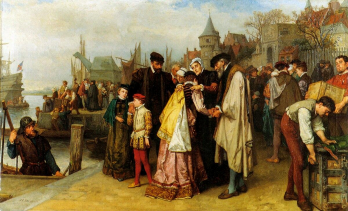
Jan Antoon Neuhuys, Emigration of the Huguenots in 1566
While I am only at the beginning of my research, and therefore cannot in good conscience determine that no archives or sources mention French Huguenot women in Ireland as refugees, it has become apparent that their existence in archives and secondary sources is vastly forgotten, or mentioned in a limited scope.
This preliminary observation seems to truly give to the 2022 ‘A new agenda for women’s and gender history in Ireland’ all its sense. There is no question that the field of women and gender history in Ireland has made tremendous progress during the last thirty years, and yet there are still many areas of research unexplored and lost voices to recover. French Huguenot women are only a small part of potentially a larger community of migrant women who came and integrated into Ireland over the centuries and whose stories have been lost.
While it is still unfortunate to observe that so many aspects of women’s history in Ireland have yet to be explored and have purposefully been ignored by historians before, there is also an excitement that comes with it. It is now up to the new generations of women and gender historians to recover those lost voices and forgotten communities of women while building on the legacy of the first women’s historians like Mary O’Dowd, Margaret MacCurtain and Maria Luddy and their first agenda.
Biography
Stella Billo
A recent graduate of the Early Modern History MPhil at Trinity College Dublin, I completed my dissertation titled ‘Réfugiées: French Huguenot Women and the Experience of Exile in Early Modern Ireland’ under the supervision of Professor Jane Ohlmeyer. Now working in the Heritage sector, I continue to research the Huguenots independently.

