
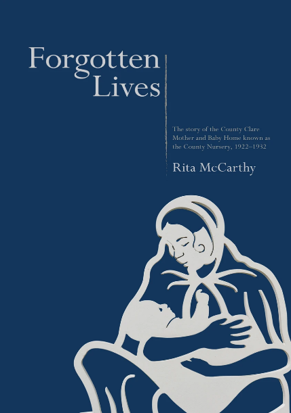
Rita McCarthy’s Forgotten Lives – The Story of the County Clare Mother and Baby Home Known as the County Nursery, 1922–1932 is an important and deeply moving contribution to the history of County Clare and to the wider story of Ireland’s mother and baby homes. This book examines an institution that operated in Kilrush for ten years, from 1922 until 1932. Through painstaking historical research, personal testimony and archival material, McCarthy brings attention to women and children whose experiences might otherwise have remained hidden. It also provides an additional perspective to the historiography of mother and baby institutions while providing the reader information on this forgotten institution in Clare, unlike the other mother and baby institutions such as Bessborough, Sean Ross Abbey and Tuam to name just three that have seen more extensive research.
The County Clare Nursery was established in 1922 in part of the former Kilrush Workhouse. It was a state-supported institution owned and funded by Clare County Council. During its first six years, it was managed by the Sisters of Mercy before responsibility passed to lay staff. Its history is particularly significant because it reveals that the system surrounding unmarried mothers was not simply a matter of religious control. Local government, social attitudes, poverty, class and the wider values of Irish society all played a role.
One of the greatest strengths of Forgotten Lives is McCarthy’s research. McCarthy has drawn upon original archives, newspaper reports, oral histories and testimony connected with the wider investigations into Ireland’s mother and baby homes. This gives the book a strong historical foundation while allowing the human stories behind the records to remain at its centre. Its core purpose being to give a voice to the mothers and babies in this institution and while doing this it also provides another example of the failures of the state to protect women and children.
The subject matter is, at times, extremely difficult to read. The conditions within the County Nursery were described as inhumane, and the medical officer responsible for the institution referred to the death rate among babies as “appalling” and “at one time the death rate in the nursery was so high that special precautions had to be taken to protect them (the babies). Two nurses had to be hired to watch them day and night” (p. 56) This particular chapter, entitled ‘children of lesser’ is deeply emotional as it gives us the names, ages and causes of death for each registered child death within the institution. These pages are extremely heartbreaking when the majority of the causes of death were related to ‘debility from birth’ (failure to thrive) and ‘marasmus’ (starvation) both avoidable causes of death (pgs. 66-73).
Reports describe a building that was badly suited to its purpose, with inadequate sanitation and other serious deficiencies. It also stated that it was partially shut down as a workhouse due to these conditions before being designated as the new county nursery home. Yet again, we see heartbreaking recollections of mothers trying to keep their babies warm in these conditions, which sometimes led to the child’s death from suffocation, for example in one case where the mother brought the baby into the bed with her to warm the infant up. The physical environment becomes more than simply a historical detail: it represents the neglect experienced by vulnerable women and children who had little power to challenge the system in which they found themselves.
An element central to this book is the attention given to the women themselves. Historical records can easily reduce people to statistics, names on documents or entries in official registers. McCarthy attempts to restore individuality to those who passed through the County Nursery. Women from different parts of County Clare entered the institution, often at moments of enormous vulnerability. Their experiences were shaped not only by what happened inside the Nursery but also by the stigma they faced outside it. However, she does note the limitations she faced in light of the timeline of the institution which meant no surviving mother could be interviewed. This quotation bringing that aspect to life “the mothers who sought shelter in the institution have all but vanished from the records and in most cases, there is no trace of what happened after they left the County Nursery. Their voices do not appear in the official records and there are only accounts of what they said or how they behaved as reported by a third party such as the nursery matron, the medical officer or visiting committee members” (p. 87).
The social stigma attached to unmarried mothers is one of the most important themes running through the book. These women were often judged harshly by their families and communities. For many, leaving the institution did not mean that their difficulties were over. Some could not simply return to their previous lives, while others carried the emotional consequences of their experiences for many years. McCarthy’s work therefore reminds us that the history of mother and baby homes cannot be understood solely by examining what happened within their walls. The attitudes of the wider community were equally important.
Particularly valuable are the oral histories concerning survivors and descendants. These personal accounts give the history an immediacy that official records alone cannot provide. McCarthy includes stories of children who were born in the nursery and later went on to lead fulfilling lives. One such story is that of Jimmy King, whose life demonstrates both survival and resilience, while also acknowledging the trauma that could remain long after childhood.
This emphasis on resilience is another admirable feature of the book. It would have been easy for a history of such a painful institution to become overwhelmingly bleak. Instead, McCarthy makes room for hope. The lives connected to the County Nursery were not all defined by suffering. Some people overcame extraordinarily difficult beginnings and built meaningful lives. Including these stories ensures that the people discussed in the book are remembered as complete human beings rather than simply as victims.
Ultimately, Forgotten Lives is a book about memory as much as it is about history. Its title is particularly appropriate because forgetting is itself part of the story. The women and children who passed through the County Nursery were often marginalised during their lives, and their experiences could remain unspoken for generations. By bringing together documents, testimony and personal stories, McCarthy challenges that silence. Overall showcasing the importance of research and books addressing similar themes to this one. The story of the County Clare Nursery reveals much about early twentieth-century Ireland: its attitudes towards women, poverty, sexuality, religion, respectability and social responsibility. Forgotten Lives, gives the women and children connected with the County Nursery a place in the historical record.
Leona Armstrong Biography
Leona Armstrong completed her B.A. in Arts Joint Honours in History and Sociology from University of Limerick and her M.A in History from the National University of Ireland, Galway. Her undergraduate thesis ‘The Forgotten Voices of Killeeneen Cumann na mBan’ was included in the Galway County Council Publication Centenary Reflections on the 1916 Rising: Galway County Perspectives. Her other published work includes her article ‘Donegal Amazon’: The extraordinary role of Eithne Coyle in the Revolutionary Period’ which was published in History Studies. While her MA thesis explored infant and maternal mortality in Ireland from 1900-1920. Leona currently is an independent scholar who researches in her spare time.

