
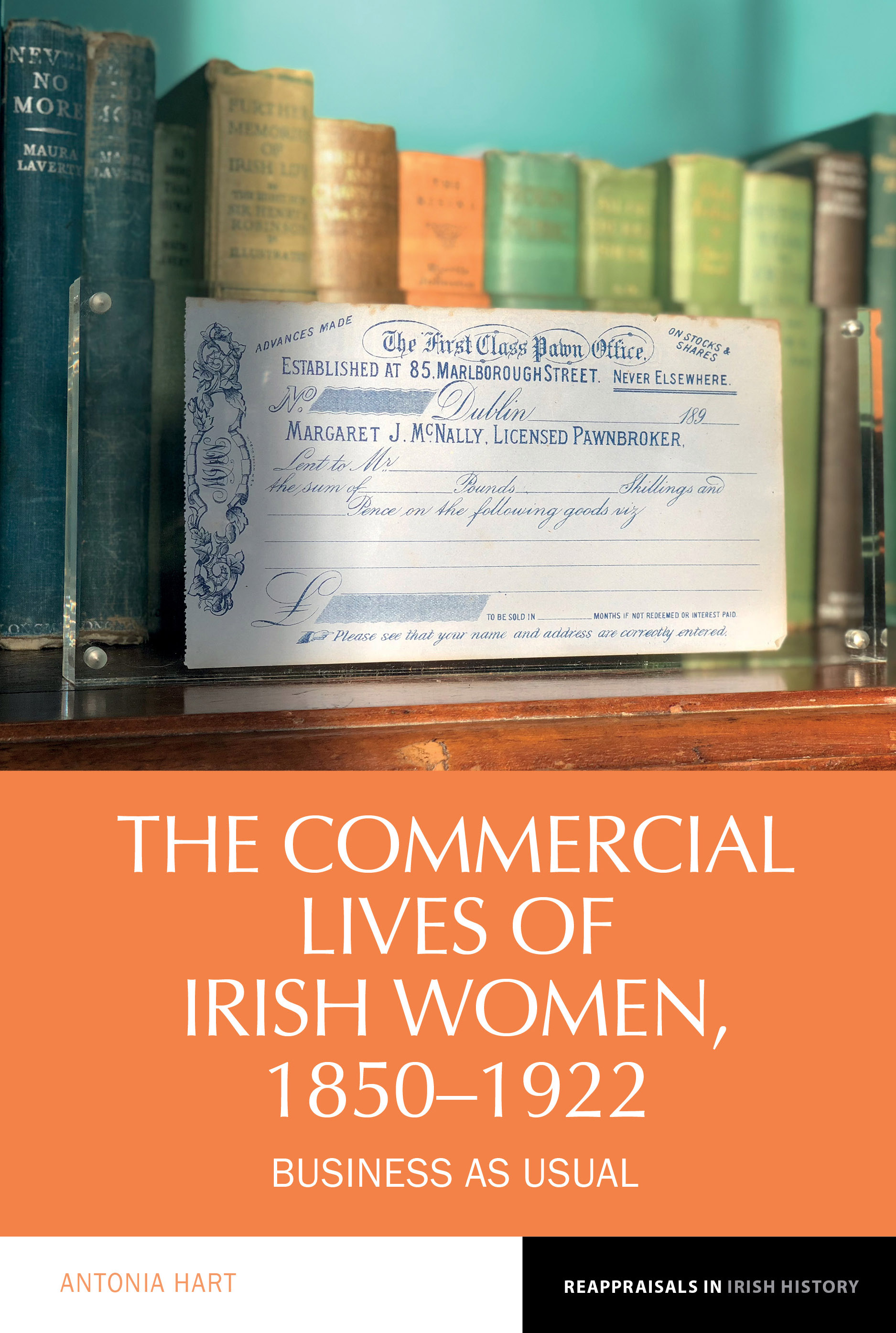
The fascinating world of women’s work as business owners is illuminated in Antonia Hart’s excellent book The Commercial Lives of Irish Women, 1850–1922 which is the twenty-fourth book published in the prestigious Reappraisals in Irish History series by Liverpool University Press, edited by Prof Maria Luddy, Prof Enda Delaney and Dr Ciaran O’Neill. Hart is an imaginative historian, vividly bringing to life the world of women who inherited, bought or started up business in the nineteenth and twentieth centuries. This book covers a key period in Irish women’s history, one that saw vast swathes of women leave Ireland for employment opportunities or larger lives than their small resources or communities in Ireland could provide. For those that stayed, self-employment offered real possibilities, including the ability to earn an income and have a stable home outside of marriage. Single women, married women and widows all engaged in businesses across Ireland, and this book brings to life their lives and work in the bustling capital, Dublin, through a creative and painstaking use of multiple sources. The methods deployed in this book – cross-referencing business directories with wills, court judgements and newspaper accounts, for example – will serve as a model for future or comparative studies. The ingenuity Hart has shown in rooting out stories from the archives is a supreme example of how the historian of lesser known women’s lives must work.
Women’s businesses were not an anomaly – Hart’s detailed case studies reveal this as a basic fact. As this book demonstrates, women owned and operated businesses could be found on the streets of many towns across Ireland, and the capital had so many that they could be passed every thirty seconds in a walk up the main thoroughfare, Sackville (later O’Connell) Street and the surrounding area. From hotels to chemists, dressmaking to confectioners, women and their businesses contributed to a lively economy in Dublin (and indeed elsewhere). Very often, those of us interested in women’s history are resurrecting long forgotten stories or pulling women’s lives out of obscure records never meant to specifically capture their histories, but from the first paragraph of this book it is clear that women business owners were never hidden. They were well known, if not always approved of, such as pawn brokers, and the individual case studies offered in this book ‘animate the numbers and percentages in the data samples’ provided (page 6) as Hart argues, in a most entertaining way.
One of the obstacles to conducting this research that Hart illuminates is the attitude of contemporary record keepers who often recorded women as having no occupation when in fact they may have been working within a family business or even operating their own. The case of Kathleen Daly (later Kathleen Clarke) highlighted by Hart seems particularly egregious. Her dressmaking business was so successful that she employed additional staff and moved to larger premises to keep up with the work, yet she is not recorded as having any occupation in the 1901 Census. This points to a long-held prejudice in Irish society that prevented women’s labour inside and outside the home as being properly named, valued or remunerated. Hart points back to Mary Cullen’s study of the household budgets of labouring families in the 1830s which demonstrated women contributed to between 15 and 25 per cent of the regular household income. This was not occasional money for treats or frivolities, as the term ‘pin money’ would often suggest, it was essential and expected. Hart’s own analysis includes calculations on women business owners’ contributions to the budget of the Dublin Metropolitan Police budget which were significant, so women’s work supported the emerging infrastructure of keeping the city safe. Hart deals with the argument that women’s involvement in the pawn broking community, associated often with crime and hence demanding policing to be done, led to respectability issues, yet she makes the case to take them seriously as business owners and an important part of the city’s infrastructure. Their lack of a vote at this time is all the more striking considering how many women business owners there were in Dublin alone, although suffrage is not a feature of this book (some cross-referencing of names on suffrage petitions could prove to be a fun exercise).
Respectability is thoroughly analysed in this book, and some of Hart’s research insights are absolute gems: in the 1890s the advertising book Industries of Dublin featured twenty-four women owned businesses and nine of these used the words ‘respected’ or ‘respectable’ in their advertising copy promoting their businesses. These terms were used frequently throughout volume by all businesses, a total of 148 times in 400 entries. These women were clearly positioning themselves as part of an esteemed world of traders; respectability was a currency all of its own.
The book is structured thematically which adds to the lively flow of the narrative through eight chapters and detailed Appendices which will be essential to further studies. Hart takes us through how many of these women came to own their businesses, their experiences of working at home, the ways in which they utilized family networks, how they negotiated gender roles and politics in their localities, contended with the issue of respectability and how failure in business was experienced.
Hart’s study surely points the way for many others who will be able to use the newly digitized 1926 Census, for example, to reconstruct women’s working lives, as employers, employees and entrepreneurs. This also points to the boon government investment in digital heritage is to the discipline of history, and it is to be hoped that this commitment to preserving, digitizing and sharing the historical records of our past continues long into the future. The introduction to the book also references the phenomenally successful Bad Bridget project which has married serious academic inquiry with public facing outputs such as their podcast, exhibition at the Ulster American Folkpark, a bestselling book and soon, a movie produced by Margot Robbie’s company. As Hart notes, this proves that ‘the hunger for knowledge about Irish women’s history is not limited to academic circles’. Hart’s own book will also prove that women’s ‘business as usual’ is an enduring interest to a wide readership.
Bio: Jennifer Redmond
Dr. Jennifer Redmond is Associate Professor in Twentieth Century Irish History in the Department of History at Maynooth University. Her research in history has a focus on identity, citizenship, and migration. She is Chair of the COST Action HIDDEN: History of Identity Documentation in European Nations which brings together scholars in different disciplines examine issues of identity documentation, historically and in the present. Her latest open access article is ‘Will there ever be enough books about women? Mary MacSwiney, biographies of women, and Irish history’. Irish Historical Studies. Published online 2026:1-4. doi:10.1017/ihs.2026.10122

