
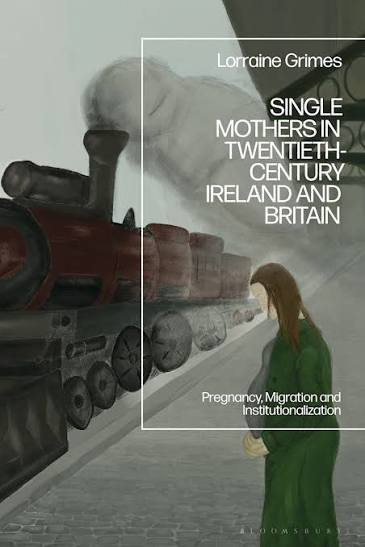
Ireland’s Mother and Baby Homes became the focus of global attention in 2014 following the discovery of 796 infant death records, for which no matching burial records could be found in Tuam, Co Galway. It was soon discovered that the bodies of these infants had been placed in a decommissioned sewerage tank. This discovery caused international shock and outrage and led to a demand for both transparency and accountability in how the Irish state and churches, both Catholic and Protestant, managed unmarried pregnancy in the twentieth century. The Commission of Investigation into Mother and Baby Homes lasted for five years, but on its conclusion refused to open key archives to researchers, thereby leaving much of this history undisclosed. Undeterred by these restrictions, Dr Lorraine Grimes makes a groundbreaking and original contribution to the literature with her 2025 study Single Mothers in twentieth-century Ireland and Britain: pregnancy, migration and institutionalization. Grimes’s study successfully overcomes archival limitations by utilising a range of sources accessible to her in British repositories. Her extensive mining of these records, combined with sensitively explored first-hand oral testimonies, allows her to challenge traditional misconceptions around unplanned pregnancy, institutional care, adoption, and the migration to Britain. The central thesis of her study is that the migration of unmarried mothers to Britain was, in most cases, not a choice but a necessity, driven by both familial and societal pressures. In an Ireland where respectability, conformity, and morality were prized above all else, unplanned pregnancy was not tolerated, and many women were left with no choice but to leave.
Chronologically, the study covers the time from 1926, the early years of the Irish Free State, to 1973 when legislative and policy changes in both Britain and Ireland influenced how unplanned pregnancy was perceived. Grimes’s study covers a broad spectrum of topics across its eight chapters, exploring the experiences of unmarried pregnant women from initial social exclusion, through institutionalisation and on to its often-traumatic aftermath. Refusing to shy away from even the most harrowing evidence, Grimes highlights examples of widespread cruelty, abuse, and neglect. She uncovers stark examples of racial prejudice, forced and illegal adoptions, and mistreatment of infants with physical and intellectual disabilities. Gina’s testimony of the systematic neglect of a baby with Down Syndrome exemplifies a level of both callous cruelty and ignorance that is almost impossible to comprehend (p. 90). Equally shocking is testimony detailing forced and illegal adoptions where ‘little kids’ were ‘handed over like sacks of spuds’ (p. 131).
The geographical focus of this study on major British cities such as London, Liverpool, Birmingham and Glasgow with high Irish emigrant populations was necessarily influenced by access to archival collections. Grimes argues that the decision to leave Ireland was seldom a matter of choice for women. Instead, she shows that a combination of intense familial surveillance, and moral policing by both church and state, together with a total lack of financial support forced many to leave. While traditional scholarship often suggests that Britain was a supportive refuge and haven for pregnant Irish women, Grimes demonstrates that this was far from the case. One of the most striking revelations in the book was the active role played by British authorities in enforcing the repatriation of unmarried pregnant women seeking entry from Ireland. Grimes reveals that a coordinated network of English welfare departments and moral protection agencies regularly intercepted these women, often at the point of entry, and sent them back to Ireland. These findings demonstrate that Britain acted neither as a haven nor refuge but was intent on minimising the financial and social costs of housing and caring for unmarried Irish mothers. She also discovered that often there was no liaison with Irish organisations to ensure that these women were taken care of once they arrived back in Ireland. (p. 145).
One of the major strengths of Grimes’s study rests upon her complex methodology that carefully side-steps archival restrictions in Ireland to focus instead on British repositories, alongside the personal testimonies of those who experienced unmarried motherhood and adoption. Using an original ‘trauma-informed ethics of care’ framework that privileges lived experience over a ‘life history’ approach, Grimes explores how her interviewees negotiated unplanned pregnancy, institutionalisation, adoption and repatriation. These firsthand testimonies, she believes, ‘provide a more realistic account of life in the institutions in comparison to archival records’ (p. 83). Further depth is added by incorporating testimonies of three nuns, a midwife, a father and an institutional employee. In dedicating a chapter to single fathers, Grimes makes a groundbreaking contribution to existing scholarship on the largely overlooked perspective of these men and their experience of unplanned pregnancy. Their inclusion ensures a far more nuanced and comprehensive account of Irish reproductive history. The scarcity of records on unmarried fathers does naturally limits an in-depth investigation but does highlight the gap in the literature and the need for greater archival access to open new avenues for further research. The chronological boundary of the of 1926 to 1973 prevents further investigation of change in the latter years of that decade, when legislative measures and changing perceptions of unmarried motherhood saw a decline in women travelling to Britain. It also restricts investigation into the earlier post-Famine nineteenth century, a time of massive social change in Ireland. Both of these points, however, offer a natural starting point from which further research could be carried out.
Ultimately, the most important contribution of Grimes’s study is its exposure of the devastating emotional cost that unplanned pregnancy and adoption had on women and their children. It reveals the deep and lasting trauma of unplanned pregnancy in twentieth-century Ireland highlighting how institutional systems forced a devastating and entirely unnecessary separation of mothers and their children. Through her extensive research Grimes sheds light on the long-term impact felt by survivors, and the deep sense of loss experienced by many adopted individuals. This granular view stands in sharp contrast to the defensive language used in official government assessments. The 2021 report shifted blame from state and church, on to families. While they did acknowledge that unmarried mothers had been ‘subject to particularly harsh treatment’, they placed responsibility for these women on ‘the fathers of their children and their own immediate families’. While conceding that harsh treatment had been ‘supported by, contributed to, and condoned by the state and church’, the report nevertheless argued that these institutions had provided a refuge at a time when families ‘provided no refuge at all’. By contrast, Grimes’s research provides a powerful critique of both state and church by showing that these agencies prioritised strict and punitive containment over basic human empathy. Through her archival research and focus on the firsthand testimonies of her interviewees, she has uncovered the reality of unplanned pregnancy, thereby refusing to allow ‘the voices of those who had the power in the past to drown out the voices of those who had none’ (p. 10). This book is essential reading for academics of twentieth-century Irish social, cultural and medical history, as well as general audiences, and individuals who have been affected by unplanned pregnancy or adoption during this era.
Bio
Dr Helen Doyle is a graduate of the History Department at Maynooth University. Her PhD research focused on the Criminal Lunatic (Ireland) Act 1838 and investigated the lived experience of those committed to Irish district lunatic asylums as ‘dangerous’ lunatics under this legislation. Helen’s PhD was supervised by the late Dr Dympna McLoughlin. At present Helen is lecturing and tutoring at Maynooth University. She is also Chair of the Carlow Historical and Archaeological Society.

