
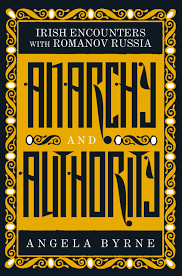
Anarchy and Authority: Irish Encounters with Romanov Russia by Angela Byrne provides and exciting and topical exploration of Irish and Russian interactions from the accession of Peter the Great in the eighteenth century to the upheavals of the Russian Revolution. With her engaging writing style, Byrne’s monograph is sure to appeal to both academic and public audiences. Incorporating a wide range of individuals across time periods, Anarchy and Authority has something for a variety of readers, whether interested in Irish soldiers fighting in the Russian Imperial Army, elite women, diplomats, domestic servants, mountaineers, or activists.
With its richness of detail, it is evident that Anarchy and Authority is grounded in long-term archival research across Ireland, Britain, and Russia. The figures discussed in the book demonstrate the complexities of identity, both Irish and Russian. In a Russian context, this included the many ethnicities and identities subsumed under the Empire. In an Irish context, Byrne includes within her discussion those born on the island of Ireland, born to Irish parents, or those who considered themselves to be Irish. Doing so, Byrne chooses ‘to emphasise the fluidity and malleability of identities that worked within and above national frameworks’ (ix).
This is particularly interesting in terms of the Irish diaspora who lived on the continent, such as the Irish military diaspora who fought for continental armies and their relatives, like Jenny O’Reilly, later known as Evgeniya Ivanovna Vyazemskaya. Her life was transnational, like many Irish belonging to European Jacobite circles. Although details prior to her marriage to Prince Andrey Ivanovich Vyazemsky and her creation of a new identity are few, it was likely that her father was one of the many Irish soldiers in Europe and that she grew up amongst this diaspora. In a Russian context, Byrne further highlights the varied roles that the Irish individuals discussed within her book played in the context of empire, from those who worked for, upheld, and benefitted from Russian imperialism, to those who belonged to radical networks.
The individuals studied in Byrne’s monograph are wide ranging in both gender and class, demonstrating how, while Irish travel to Russia may have less common than to other areas of Europe, it was not merely the purview of a smattering of eccentrics. Irish people lived and travelled in Russia as diplomats, as soldiers in the service of the Russian Empire, as tourists, writers, maids, nannies, and activists. Particularly of interest to readers of WHAI book reviews are the many chapters dedicated to Irish women in Russia, including: Jenny O’Reilly/Evgeniya Ivanovna Vyazemskaya, the Wilmot sisters, Eleanor Cavanagh, Selina Bunbury, Lady Dufferin, Ethel Lilian Boole Voynich, and Margaretta Eagar.
I was particularly captivated by the chapter on Martha and Katherine Wilmot and their relationship with Princess Dashkova, a central figure in the Russian Enlightenment. Through connections made in Spa, Belgium, Princess Dashkova visited Ireland and developed relationships that ultimately resulted in Martha and Katherine Wilmot’s extended visit to Russia. Martha Wilmot encouraged Dashkova to write her memoirs, which Wilmot eventually translated and edited for publication, resulting in one of the most important English-language sources for nineteenth-century Russia (47). Byrne further provides an interesting counter to this chapter with the following one on Eleanor Cavanagh, lady’s maid to Katherine Wilmot, whose own experiences and observations on life in Russia were somewhat different to those of her employer and provide a peek into the world of non-elite women travellers, whose voices are often absent from the written record. It does not surprise me that the origins of this book start with the world of the Wilmots, who were the subjects of Byrne’s postdoctoral work, which prompted her to later expand her research to a wider range of Irish encounters with Russia.
Byrne’s monograph is particularly relevant today in the context of the ongoing Russian invasion of Ukraine. From the outset, she places her work amongst the history of the Russian state’s aggressive expansionism, writing that ‘the interactions studied in this book almost entirely took place against the backdrop of war, imperial expansion, violence and oppression’ (xii). Perhaps the only downside of the book is that it feels like it is only the tip of the iceberg. Anarchy and Authority provides a fascinating and tantalising glimpse into two centuries of Irish-Russian interactions and exchanges, and the richness of source material discussed shows how much potential for future research there is in the area, particularly in the context of Irish women in Russia.
Bio Kristina Decker
Kristina Decker will shortly be completing a PhD in history at University College Cork. She was awarded a Government of Ireland Postgraduate Scholarship from the Irish Research Council for her research project, ‘Women and Improvement in Eighteenth-Century Ireland: the Case of Mary Delany (1700-1788)’ and previously received a Desmond Guinness Scholarship from the Irish Georgian Society for her work on Mary Delany and the decorative arts in Ireland.
 Women's History Association of Ireland