
Frances ‘Frank’ Brady is one of the few members of Cumann na mBan who went on hunger strike during the War of Independence, and more unusually, for whom a photograph exists of her in bed, in jail, on hunger strike.

She was born in Belfast and was working as a civil servant in the War Office in London when summoned by Michael Collins. Her position made her an ideal person to conduct espionage in her workplace and supply information to Collins – this she did until 1919 when the Post Office was demobilised, and she was made redundant. All this information on Brady which is contained in the meticulously researched short biographies of the Cumann na mBan women in this book, fill in the gaps in our knowledge and demonstrates why a Belfast women ended up in Mountjoy Jail on hunger strike in 1921.
Brady returned to Belfast when made redundant, joined Cumann na mBan and continued her work alongside the revolutionary men, travelling to Dublin to act as secretary to Joseph MacDonagh, who was in charge of the Belfast Boycott. It was during a raid on 46 Lower Leeson Street (where Frank’s sister Kay lived) that she was discovered burning papers; she was also found in possession of a revolver and a Cumann na mBan brooch, and was arrested, court martialled and sentenced to two years hard labour in Mountjoy Jail.
All this detail gives a new understanding of the importance of the work undertaken by Frances Brady, and her connections with many of the senior men and women of the revolutionary movement, during the War of Independence. However, she was not the only Brady of note, her sister Kay (Kathleen) on whom Ward gives as much detail, was also an important Cumann na mBan activist during this period, and on into the Civil War. From 1919 Kay was living in Dublin, when she bought a house at 46 Lower Leeson St., the same house in which her sister Frank was arrested. Kay carried dispatches and arms between Dublin and Belfast during the War on Independence and was a very important source of information on the plight of the northern nationalist community during the pogroms of 1922; she worked with Erskine Childers to publish a pamphlet on the dire situation of Catholics in Belfast. Like so many Cumann na mBan women Kay Brady was anti-treaty and participated in the battle for Dublin. She continued her anti-treaty work until her arrest in March 1923, when she was found in possession of a huge sum of money, £4,000, which the Free State authorities determined was ‘being channelled to the irregulars’. Like her sister before her Kay found herself in prison, firstly in Kilmainham and then in the North Dublin Union (NDU). On 7 May 1923, 22 women escaped from the NDU, but only three, Éilis Robinson, Maureen Power and Kay Brady avoided recapture. In August 1923 she was sent by de Valera to the USA, as part of the Irish Women’s Mission who were commissioned to fundraise and to explain the anti-treaty position to Irish America. At the same time, back in Belfast, Frank, who was also anti-treaty, was disturbing anti-treaty newspapers, Éire and Sinn Féin.
Obviously once the Civil War ended the sisters found themselves on the losing side, but their stories do not end there. Acknowledging that revolutionary women had ‘afterlives’ on into the next decades, Ward provides, where the archives allow, rich and detailed histories of the women who at the centre of this book. It is the fact that many of these women have their ‘afterlives’ north of the border, in Northern Ireland, that makes this book so interesting and so valuable. While we have numerous works on revolutionary women, not least from Ward herself, most of these works concentrate on women who lived, worked and were active, during the War of Independence and Civil War and subsequent decades, mainly in the twenty-six counties that become the Irish Free State and subsequent Irish Republic. As War notes those left ‘on the wrong side of partition’ were often dealing with a legacy of hurt and abandonment.
While the rich resource of the military pension application files and other archives in the south have enhanced our knowledge and understanding of the lives and afterlives of revolutionary women, it is notable that fewer women ‘north of the border’ appear in these sources. For instance, while 146 women gave witness statements to the Bureau of Military History, only four were from women active in Belfast – two of whom were the daughters of James Connolly, Nora and Ina, both living in Dublin at that time. Yet we do know that northern women were as involved in revolutionary activism as their southern sisters. Ward gives interesting insights and rationales behind their relative absence – reticence in remembering while living under a hostile unionist government, which outlawed and kept republicans under constant surveillance. Notes, letters, memoirs on their time as revolutionaries could be discovered during house raids, letters to the pension authorities to pursue their claims could be intercepted. As Elizabeth Delaney, O/C of the Craobh Iarthar (West Belfast) branch of Cumann na mBan noted it was very difficult for the women to procure statements to back up their claims to the pension authorities situated [as they were] ‘…in Northern Ireland, with a hostile censorship’ and most people who could vouch for them were now living in ‘Eire’.
Despite these difficulties Ward, ever the diligent and meticulous researcher, managed to find applications by 321 northern women, and chose to write on the women active in Antrim, an overwhelmingly Protestant county with two distinct areas of republican activity – Belfast and the Glens. Belfast as a case study is important, especially as this is one of the few areas on the island where there was huge employment of women, in the textile industries. It is also where nationalists, only 25% of the population in the city, bore the awful brunt of terror, particularly during the pogroms. Interestingly it was through public engagement that her research began into the women the Glens- as with much women’s history research, it can start with a conversation, a newspaper article, a radio call out – and then, so called ‘forgotten’ histories, well known within families, are shared and made public.
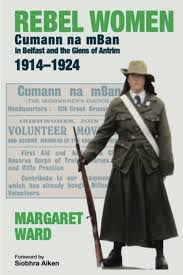
The book begins with contextual chapters which explain the formation of Cumann an mBan and the Ulster context and as well what the organisation did during the period of the War of Independence and Civil War. The activities of the Belfast women were similar to those women who were active in other parts of the country in the initial phase of the war, but the histories of republicans (female and male) in northern Ireland begin to diverge from those in the south after the Government of Ireland Act (1920), which created two separate states on the island of Ireland. The northern women, still fighting for a 32-county republic, were now doing so, as a marginalised minority in a very hostile, violent, and from Ward writes, exceedingly misogynistic State. The frenzy of violence unleashed in Belfast in July 1921 saw families, women, and children, burnt out and 16 dead. Women were treated as legitimate targets – with an upsurge in forcible hair-cropping in the Belfast and beyond, while nationalist women were subject to sexual assault by the B Specials. In this violent, difficult environment the women of Belfast Cumann na mBan continued their work, activist Neille O’Boyne saying that there was no Truce in Belfast. They moved arms and ammunition, they carried messages and dispatches, they visited imprisoned men at Crumlin Rd., and once the Treaty was signed (and rejected by Cumann na mBan) they prepared for the Northern Offensive.
The raids and arrests by the RUC and B Specials depleted the Belfast IRA, and many women could no longer safely perform their duties. As few like Molly Kerr were themselves arrested and imprisoned, so by the time the civil war began only 16 women from Belfast were still active, moving arms, delivering despatches, doing what they could despite great difficulties. A number ended up in prison with hundreds of southern anti-treaty women in Dublin, in Kilmainham, Mountjoy and the North Dublin Union. Post civil war none had particularly easy lives, some remained in Belfast and the Glens, others left for Dublin, England or America. Ward gives us short biographies of over 50 of these women. While this is only a fraction of the numbers who were in Cumann na mBan in the northern counties these biographical case studies give detailed insights into the contributions, experiences and afterlives of northern women, often lacking in other histories of revolutionary women.
Like so many Cumann na mBan women their pension applications are revealing, many were living in difficult economic circumstances, many were under surveillance and felt their lives constrained by the attentions of the police. What their applications reveal is the difficulties so many had in persuading the assessors of the worth of their revolutionary work. Una McCrudden of the Belfast central branch was angry that the referee treated her pension claim as through she was an ‘ordinary imposter’. Her comrade Bridie O’Farrell was denied her pension despite a note from a referee stating that she ‘never spared herself in the national movement’. Unfortunately, this type of response from the pension application authorities to Cumann na mBan women was not unusual, north or south.
Margaret Ward is to be congratulated in adding another scrupulously researched, thoughtfully analysed piece of work on revolutionary women to her already impressive canon of books, articles and publications. From Unmanageable Revolutionaries: Women and Irish Nationalism, first published in 1983 and updated in 2021, through her works on Hanna Sheehy Skeffington and Maud Gonne, as were as edited collections and journal articles, she has been at forefront of Irish women’s history, using a feminist and gendered lens to research, analyse and write about Ireland’s revolutionary women. This book shines a light on another group of overlooked women, adding complexity and nuance to the histories of the revolutionary lives and afterlives of northern women.
 Women's History Association of Ireland