
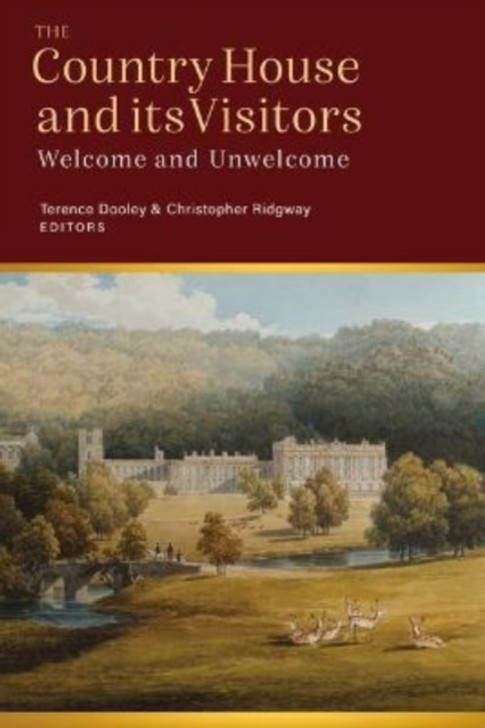
Visitors to the Country House in Ireland and Britain: Welcome and Unwelcome, an edited volume by Terence Dooley and Christopher Ridgway, is unusual in the variety of perspectives it offers on the concept of the country house. It contains eleven chapters aligned to the theme, ranging from a focus on one man’s life and personal papers, to wide-ranging discussion of centuries of country houses surviving wars, ransacking, dereliction, pests, and worst of all, tourists. The chapters span a broad range and differ greatly geographically, chronologically, and even in methodology.
Christopher Ridgway, Editor, makes an admirable attempt to connect and bookend the chapters. His summary of the chapters and passionate call to arms for future research on the subject starts the volume in style (Introduction), followed by discussion of friends and foes alike (Chapters 1 & 11). Chapter 1 sets the scene for a volume full of excellent research, and no chapter disappoints. Each chapter offers a fascinatingly detailed insight into a particular theme, location, family, archive, or time period. Each author engages with primary sources in depth, often textual such as letters or diaries, sometimes visual in furniture or art, but most uniquely, the combination of visual and textual in the exploration of visitor logbooks, recording notable visitors to each house.
For women’s history, contributor Fran Baker (Chapter 1) focuses on Elizabeth Gaskell (1810-65), and how women’s privileged access to the country home might be facilitated through the ‘aristocracy of the intellect’. (p. 74). Baker demonstrates how Gaskell’s research on the life of author Charlotte Bronte brought her social capital- a result likely familiar to many scholars of culturally-renowned men. In Philip J. Carstairs’ chapter on soup kitchens and country-house charity 1795-1914, we see glimpses of gendered society in the demographics of those receiving charity, the physical routes to accessing charity, and interestingly, changing attitudes to the (British) poor over time. Other chapters also expose underpinning social norms, for example, Vita Sackville-West in the 1920s who loved but was not able to inherit Knole, which was entailed to her uncle, inherited by her cousin, and eventually managed by the UK National Trust (p. 130).
For Irish perspectives, Ian D’Alton’s chapter on the Irish country house (Chapter 8) takes a unique approach of thinking about visitors through the lens of ‘collecting’ between the 1820s and 1930s- thereby producing an excellent logbook records visitors of the peerage and/or the upper class. The very act of signing could place different guests in the same frame, including James McNeill, who signed in both Irish and English (p.186). In Chapter 10, John Knightly explores the remarkable life of Major Markham Richard Leeson Marshall (1859-1939), great-great-grandson of the first Earl of Milltown. His diaries, letters to his daughter, and logbook reveal how ‘visitors’ to Callinafercy House, Kerry, mirrored contemporary events, including tensions between the landed gentry and the IRA. Knightly contextualises Markham’s experience with that of his neighbours, and readers may be interested to consider the insights this offers into gendered experiences of owning a country house.
Shaun Evans’ chapter on the ‘plas’ in Wales (1778-83), through the writing of Thomas Pennant, explores how the ‘imagined community’ of Wales was influenced by travel journals, guides, and word of mouth, which impacted the expectations of both visitors to Wales, and the homeowners themselves (Chapter 9). The potential parallels to the Irish context are illuminating, especially where casual movement between country houses in Britain and Ireland is revealed. For example, in Chapter 7 Oliver Cox notes that Lambay Island, Dublin, was visited by Christopher Hussey, writer for Country Life magazine 1920-70, whose prolific visits to country houses were often an opportunity to pen articles describing them in detail (p.166).
For the realities of visiting the country house, the architecturally-minded Thomas Sandy-Nottingham may be of interest, as according to Kerry Bristol in Chapter 3, he saw no need on his 1774 tour to view the interior of any house he deemed less than interesting in terms of its exterior. Visitors were not always admitted – Peter Collinge in Chapter 6 discusses homeowners between 1719 and 1838 who limited access to houses – despite expectations set by guidebooks, actual visitations might be limited to specific days, hours, or blocked by pecuniary-minded servants. Limited access was not always successful in a context where tourism could be key to financially supporting an estate and its neighbours- as John Coleman notes in his chapter on Knole, 1456-2018 (Chapter 5), in 1874, efforts to reduce visitor numbers met with strong local opposition.
In terms of critique, the order of chapters is alphabetical by author surname, where a chronological approach might be easier for the reader, given that not every chapter title offers a date range. The inclusion of an excellent Index does ameliorate any difficulty in using the volume towards a specific research question. The volume arose from the Annual Historic Houses Conference held at the Centre for the Study of Historic Irish Houses and Estates at Maynooth University, where both editors are based, which explains the diversity of research in the chapters. The only remaining criticism to make might be the lack of colour imagery, which is unfortunate in light of the tantalising glimpses of visitor logbooks turned artist sketchbooks and scrapbooks all in one- however, this decision is often financial, and it must be admitted that there are an admirable amount of illustrations included throughout.
In summary, this volume is a welcome addition to the field by the Editors and offers a fascinating read revealing a huge amount of scholarly effort and archival work on the part of the authors. It includes a wealth of primary research and explores many unique perspectives, not least offering new insights into the tensions of the Irish country house, country houses as microcosms of wider society including gender biases, and the ever-present societal conflict between public and private.
Dr Maeve O’Dwyer, Academic Developer at DCU, researches the long eighteenth century, portraiture, pedagogy, and third space professionals in Higher Education
 Women's History Association of Ireland