
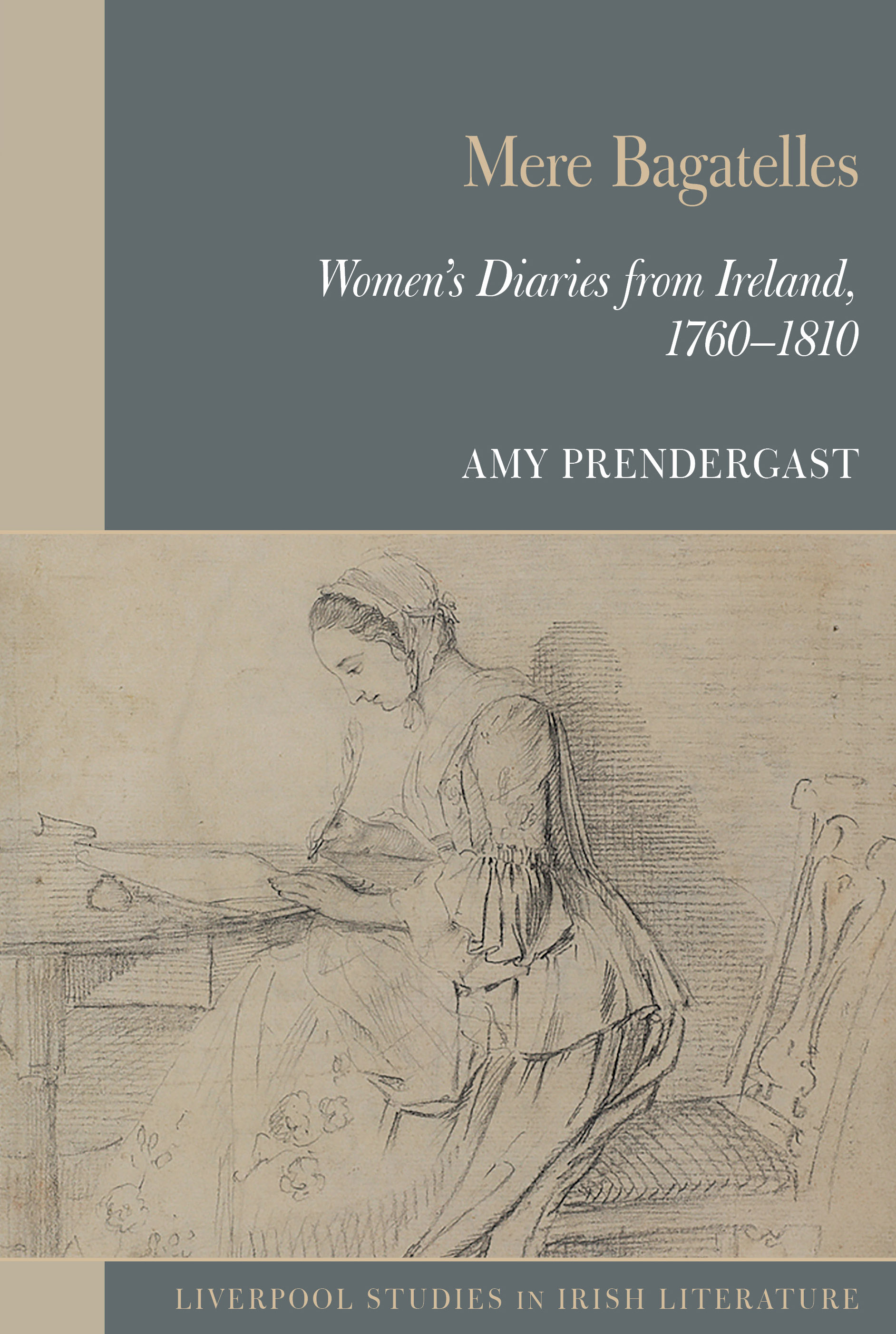
Diary-keeping will likely have two main associations for readers of this review: as an archive of teenage dramas and secrets, and as a habit-making tool to aid mindfulness and improve mental health. But in the eighteenth century, diaries served a wealth of purposes. Some diarists were motivated by their faith, seeking moral self-improvement through the daily tracking of habits, thoughts and feelings. Others kept diaries only during exceptional periods, such as while travelling or during periods of civil unrest. Records of quotidian minutiae, repositories of pain and loss, logs of learning and intellectual development, diversions composed to entertain friends – Irish women’s diaries reveal themselves in all their richness in Amy Prendergast’s fascinating new book.
The study of Irish autobiography has evolved rapidly over the past twenty-five years, and among this book’s contributions is its emphasis on – and, indeed, celebration of – the original manuscript diary, both as an Enlightenment genre and as the primary form that women’s writing took in the period. Making the case for manuscript diaries as the source par excellence for the insights they offer into the intellectual lives of eighteenth-century women, Prendergast writes, ‘the surviving diaries offer a strong counterargument to the widespread exclusion of Irish women from Enlightenment scholarship. Rejection of manuscript material … alters our understanding of Enlightenment output and participants’ (141).
Prendergast argues – and reiteration of this point is still necessary – that diaries are not a private form, no matter the presumptions of modern readers and historians. They were often intended for circulation among family and close friends, and capture the literary aspirations of their authors. Elizabeth Edgeworth, for example – sister of the novelist – attempted to secure an audience for her diary by privileging the lives of her famous father and sister over her own. As Prendergast puts it, Elizabeth became ‘a minor character in her own life’ (42). The less-famous members of the Edgeworth family found themselves marginalised by the collective effort of supporting Maria’s writing, preventing them from pursuing their own literary ambitions – a dynamic borne out in Elizabeth’s inability to present her own life as significant, opting instead to record her father’s activities during the 1798 rebellion.
With judiciously chosen examples, Prendergast demonstrates the ways in which a long-term disregard for women’s diaries and a reliance on inadequate editions have resulted in biographical inaccuracies and misunderstandings. Edited extracts of the life writings of Melesina Chenevix Trench, for instance, were published by her son in 1862. Prendergast demonstrates how his editorial focus on his mother’s interactions with celebrated European figures generated the inaccurate but pervasive image of a socialite, eliding Trench’s political opinions and negating the care and precision with which she recorded her life in her manuscript diaries.
While these texts were, for the most part, never intended to remain completely private, I share Prendergast’s reservations about dealing with these most intimate of sources respectfully. The sections on domestic and gender-based violence and pregnancy and child loss are handled sensitively, the women’s (often difficult) testimonies given primacy. Women struggled to voice experiences like sexual assault, often lacking the language to do so; and while diaries offered women the opportunity to record, testify to and process traumatic events, many silences must of course remain.
Mere Bagatelles celebrates the multifunctionality of the eighteenth-century Irish woman’s diary as a mode of self-fashioning and self-expression that defies categorisation. Playing with – even confounding – the bounds of genre and form, the diaries reveal, in Prendergast’s words, ‘many instances of generic intersections, experimentation, and innovation, showcasing the literary and cultural cross-fertilisation that was so widespread in the eighteenth century’ (5). The book reflects this malleability, moving between literary criticism, the history of emotions and the family, and ecocriticism. The latter receives striking attention with considered analysis of the physical environment within which diaries were produced – largely, landed estates – that constructed visions of the Irish countryside that worked to simultaneously ‘improve’ the writer and her physical surroundings through the erasure of an impoverished tenantry or idealisation of the countryside.
As a work of literary criticism, this book has much to offer historians in terms of methodology and approach. The lessons gleaned from the comparative close-reading of edited diaries versus the original manuscripts (cited above), are instructive. Further, the treatment of the diaries as literary works elevates them beyond the status of a record of the details of a life, into a largely underappreciated form of Enlightenment discourse in which women excelled. Space is given to consideration of the dearth of Irish-language diaries in the period, and to the confessional imbalance (protestant women are over-represented). So too is the thorny question of identities, ranging from the ‘emerging sense of selfhood’ in adolescence (75) to the effect of overseas travel in augmenting self-conscious performance of Irishness.
Mere Bagatelles is an excellent piece of scholarship, an absorbing read and a significant addition to early modern Irish women’s studies. The voices of the women themselves are given primacy; the text brims with their feelings and experiences: some humorous, many devastating. The fact that the subjects of study are, unavoidably, not representative of the majority of women living in Ireland in the period cannot detract from its fresh insights and the broader contributions it makes to the study of women’s writing and life writing.
It is to be additionally welcomed that an Open Access edition of this valuable book is available on the Liverpool University Press website.
Dr Angela Byrne FRHistS FHEA is an editor with the Dictionary of Irish Biography (Royal Irish Academy). Her most recent book is Anarchy and Authority: Irish Encounters with Romanov Russia (Lilliput Press, 2024).
 Women's History Association of Ireland