
Reviewed by Rachel Sayers
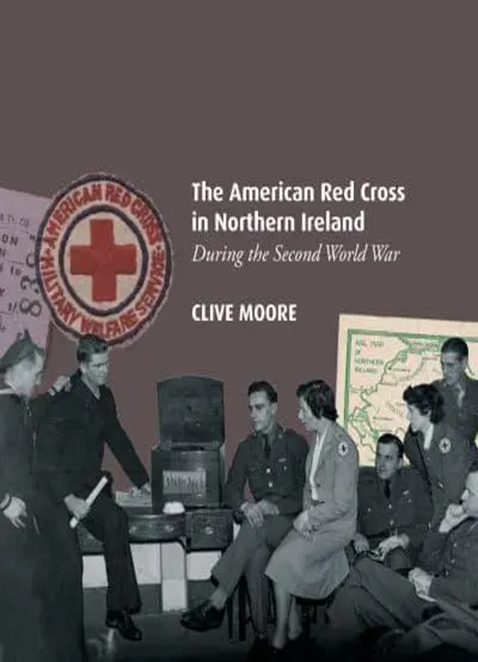
An informative, and interesting read The American Red Cross in Northern Ireland During the Second World War details the crucial role the American Red Cross (hereafter ARC) played in Northern Ireland between 1942 and 1945 through their provision of support, recreational, and leisure facilities that served American personnel either serving in or on leave in Northern Ireland. Clive Moore has utilised a wide array of archival, historical, literary, and museum-based sources to present a detailed picture of the ARC’s activities across Northern Ireland. These activities included service clubs, mobile canteens, advice centres, as well as organising visits to civilian homes in areas where access to ARC services were not easily accessible. Additionally, Moore does not only concentrate on the population centres of Derry/Londonderry, and Belfast but also the role of the ARC in rural areas such as the Mourne Mountains and Glens of Antrim. This all-encompassing approach to research enables the reader to understand how pivotal the ARC was in providing support and recreational facilities to serving members of America’s armed forces from the most remote areas to city and town centres.
Moore uses an object centric approach to historical research with several large, colour, and full-size photographs of these objects inserted throughout the book. These objects vary from ARC uniforms, photographs, printed material, and other related objects. This juxtaposing of object-based research and information gleaned from archival and literary sources are found throughout the entirety of the book. Of note on pg.30 is a surviving example of an ARC volunteer’s indoor uniform consisting of a long-sleeved grey poplin dress with epaulettes indicating the role of the volunteer. Though no details are provided of who wore the uniform, similar uniforms can be seen being worn by ARC staff in photographs throughout the book. The poplin dress was worn by a female member of the ARC in Belfast and there is a strong emphasis on the significant role that women civilians, official ARC personnel, and serving American and British female army, navy, and Airforce personnel played in the running of the ARC throughout the book.
This book also discusses the role that the ARC played during World War One when they were briefly stationed in Belfast before expanding on the relationship with Northern Ireland after partition in 1921. This section highlights that certain members of the American community in Northern Ireland were active in the Inter-War years and went on to play a pivotal role in the ARC in World War Two. Again, prominence is given to the role of women with profiles on several women including Marcia Mackie, who became the first female director of a service club outside of the US, Louisa Farrand, who volunteered with the ARC for overseas duty in Northern Ireland, and Francis Lux, who helped establish one of the first ARC’s ‘Aero Clubs’ in Toome, County Antrim.
Following on from the establishment of the ARC this book has sections dedicated to the activities, events, and other contributions the ARC made to life during wartime Northern Ireland. Of interest to readers is the role that American sports such as baseball and American football played in the recreational activities of the ARC. Baseball games were played in Belfast between US Army, Naval, and Air Force staff whilst female ARC staff held hockey matches between the staff of different ARC centres. Moore also highlights the impact that American service personnel had on the every-day life of Northern Ireland particularly their interaction with civilians. Moore utilises photographic evidence of US service personnel and ARC staff providing children with Christmas gifts, establishing an orphan fund for victims of the Belfast Blitz, and supplying civilians with extra food to supplement their rations.
The wide breadth of original material utilised within this book enables the reader to understand how far-reaching and extensive the role of the ARC was within Northern Ireland. This role also included providing amenities to Black troops who were at this time still segregated from their white counterparts of the US armed forces. The ARC provided two ‘black only’ rest-centres in Belfast and Antrim with facilities in other places being allocated on a timetable basis as seen in the example of Newry (pg.73) where the local ARC centre was available for Black troops until 17:00 before the town became divided between Black troops to the west-side of the town, and white troops to the east-side of the town.
Whilst there was no enforced colour bar in Northern Ireland it is worthwhile noting that hitherto histories of the Second World War in Northern Ireland offer little or no indication of the experience of Black troops arriving in a country for the first time where they were considered equal citizens. Moore’s inclusion of the stories of Black troops, including Black female ARC staff Mary L Divers and First Lieutenant Mulrose, US Army Chaplain, gives a well-rounded view of the experiences of these troops who were well treated by many members of society across Northern Ireland.
This book offers the reader a well-researched, and thoroughly written history of the vital role that the American Red Cross played in Northern Ireland during World War Two. The use of primary sources juxtaposed against secondary research gives a broad synopsis of the varied activities of the ARC from providing rest-centres to providing advice to troops on leave from active duty. Of particular interest to scholars of women’s history is the importance given to women’s role within the ARC with several pages highlighting prominent female figures within the ARC as well as a focus on objects used or worn by female members of the ARC. This is an extremely valuable work that highlights the role of Northern Ireland during the Second World War that also offers a fresh overview by including stories of marginalised communities who also played a significant role in the war; a must-read for historians of World War Two, America, and women’s history alike.
Rachel Sayers is a dress historian, curator, and blogger whose practice as an historian investigates the role dress had in the social, cultural, and domestic lives of Irish women between 1900 and 1970. Rachel has worked with and volunteered amongst other organisations for the National Trust for Scotland, National Museums Northern Ireland, The Marks & Spencer Archive, and the National Trust in a variety of roles including curation, collections management, and research. Rachel is currently researching the role of the Flapper and Modern Girl in 1920s and 1930s Ireland and the role of the Women’s Royal Naval Service in Belfast during World War Two.
 Women's History Association of Ireland